




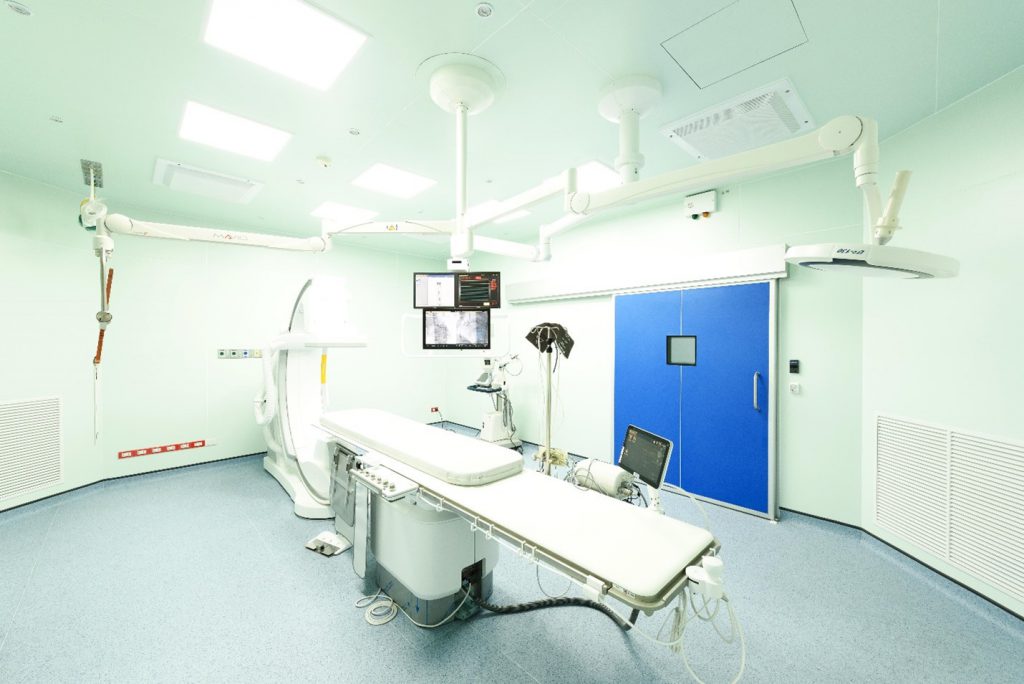
Physical and Design Requirements
- The operating theater must provide space for one surgical bed and associated life-support equipment per room.
- The operating theater must be located within a Sterile Area with controlled access.
- The minimum floor area of the operating theater should not be less than 25 square meters, and the narrowest part of the room should be no less than 5 meters wide.
- A dedicated separate pathway for dirty or contaminated waste should be provided, distinct from the main entrance route.
Floor and Surface Standards
- Flooring must be abrasion-resistant, able to withstand heavy equipment loads, chemically resistant, static-dissipative, smooth, with minimal seams or joints, non-slippery, and non-absorbent to liquids.
- Wall surfaces must be chemical-resistant, smooth, without sharp edges, with minimal seams, and not allow accumulation of dust, dirt, or microbes. Compact laminate materials are commonly used.
- Ceiling finish should be smooth without joints or porosity, resistant to dust and moisture, and designed with sealed edges and corners.
- The ceiling height of the operating theater should be no less than 3.00 meters.
Doors and Access Control
- Surgical doors should minimize direct hand contact; automatic doors are preferable. Door openings must be at least 1.50 meters wide with viewing windows where appropriate.
- A separate dirty transfer door should be provided, with a minimum width of 0.7 meters, to conveniently handle contaminated materials.
- Operating room doors should be designed to maintain air containment to support temperature and air pressure control.
Windows and Equipment
- Windows and light openings must prevent entry of insects or animals that can carry contaminants.
- Fixtures and equipment materials used in the operating theater must be easy to clean, durable, free of sharp edges, and not retain contaminants.
Floor Level and Department Access
- Floor levels within the surgical department should be continuous and level (no variation), and there must be a controlled access system into the operating department.
Additional International Best Practices (Contextual Reference)
While the KT-Inter article focuses on physical construction and finishes, international standards for operating theaters also include:
- Air handling and ventilation systems with controlled pressure, HEPA filtration, and adequate air changes per hour to support infection control.
- Functional adjacencies such as proximity to anesthesia induction areas, intensive care units, and specialized support spaces.
- Sterile zoning and traffic flow design to separate clean and dirty areas and optimize workflow.
